Personalized brushing is becoming an important product-development direction because many smart toothbrushes still treat different users in similar ways. The next step is moving beyond connectivity toward sensors, brushing behavior recognition, real-time guidance, and adaptive feedback that support better daily brushing habits.
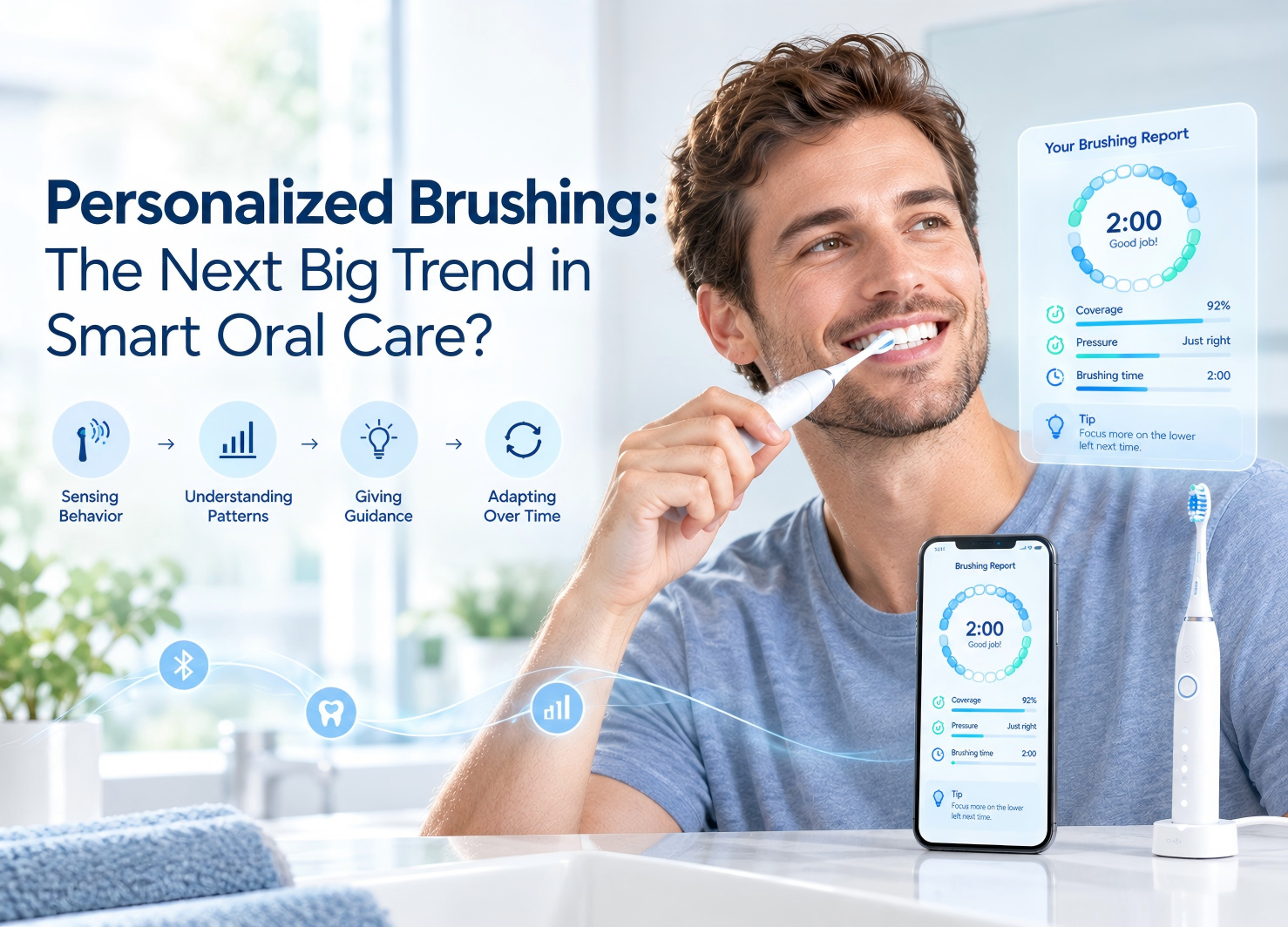
Personalized brushing means using individual brushing data, sensor inputs, brushing analytics, and intelligent feedback to guide users based on how they actually brush. The opportunity is not simply adding more modes or app screens, but building a closed loop: sensing behavior → understanding patterns → giving guidance → adapting over time.
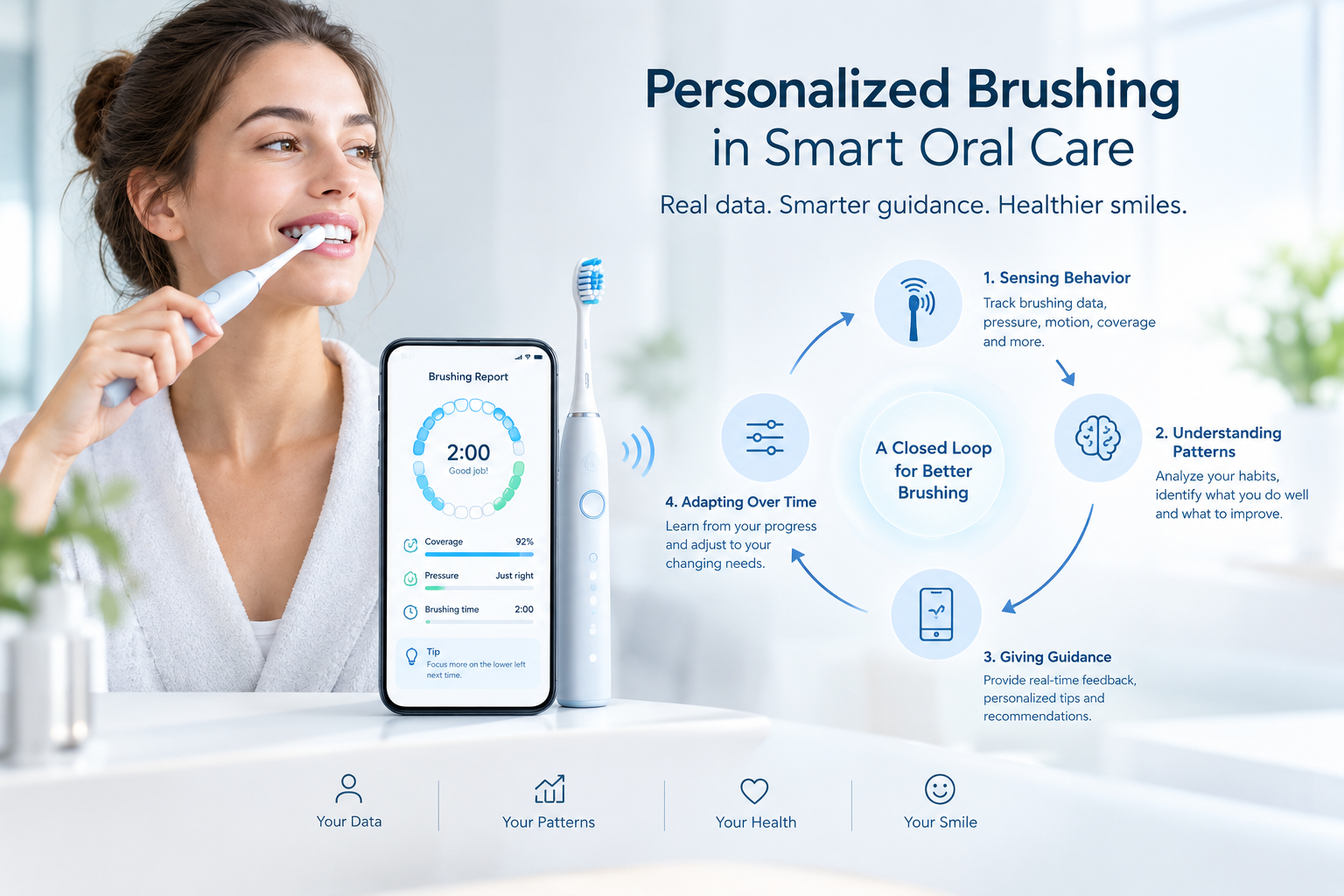
This trend matters from a product and OEM/ODM perspective. The key questions are: What should brands build next, and what should procurement teams evaluate when selecting a smart toothbrush supplier?
Why Is Personalized Brushing Becoming the Next Competitive Frontier in Smart Oral Care?
Many smart toothbrushes now offer similar features: sonic motors, pressure sensors, timers, multiple modes, and companion apps. That makes differentiation harder. Personalized brushing creates a stronger path by connecting product value to actual user behavior.
The market is moving beyond “connected” as a selling point. Early smart toothbrushes gained attention through Bluetooth and app connectivity. Today, connectivity alone does not mean the device understands the user. The category is increasingly moving from passive data collection toward behavior-aware guidance.
A practical technology-evolution framework
| Stage | Main Product Logic | Typical Features |
|---|---|---|
| First generation | Preset cleaning | Clean, sensitive, whitening modes |
| Second generation | Connected brushing | App sync, timer, history |
| Third generation | Personalized feedback | Pressure alerts, habit insights |
| Fourth generation | Spatial awareness + guidance | Zone recognition, coverage coaching |
| Fifth generation | Adaptive brushing + on-device AI | Local analysis, adaptive feedback |
This is an analytical framework, not an official industry classification. These stages overlap in the market.
Leading brands show the direction
Philips Sonicare and Oral-B provide useful examples of premium smart-toothbrush development. Philips describes SenseIQ in selected products as sensing brushing behavior such as pressure, motion, and coverage, while selected Oral-B iO products use AI position detection and pressure guidance. These products illustrate the direction of premium electric toothbrush technology rather than proving that the market is already fully personalized.
For B2B buyers, the value is strategic: personalization can create stronger product differentiation, higher perceived value, and a more defensible user experience than simply adding more brushing modes.
For OEM/ODM projects, however, personalization is a system problem. Suppliers may need to integrate sensor architecture, firmware, app development, calibration, manufacturing quality control, and compliance documentation.
> Important: Brushing behavior monitoring is not medical diagnosis. Consumer smart toothbrushes should not claim to diagnose cavities or gum disease, or replace dental visits, unless the specific claim is supported by appropriate evidence and regulatory approval.
How Is Personalized Brushing Moving From Multiple Brushing Modes to Individual Brushing Profiles?
Many electric toothbrushes still use preset modes as their main personalization feature. A “sensitive” mode may change intensity, but it does not know whether a user consistently brushes too hard on molars, misses the gumline, or moves too quickly across inner surfaces.
A more advanced individual brushing profile can combine factors such as duration, pressure, motion, angle, intensity preference, and coverage behavior.
What can an individual brushing profile include?
- Duration: Does the user consistently reach two minutes?
- Pressure: Does excessive force occur, and in which areas?
- Motion: Does the user scrub aggressively or move too quickly?
- Coverage: Are particular quadrants or surfaces repeatedly missed?
- Usage pattern: Are sessions consistent, or does the user need offline guidance?
- Preference: Does the user respond better to lower intensity or different feedback channels?
The American Dental Association recommends brushing twice a day for two minutes with fluoride toothpaste. Personalized brushing can add value by helping users understand how they brush during those sessions.
What this means for OEM/ODM development
Instead of a brief such as “five modes plus Bluetooth,” a next-generation product brief may require a behavior-recognition platform.
| Development Area | Basic Product | Personalized Product |
|---|---|---|
| Motor control | Fixed intensity | Adaptive logic |
| Sensors | Timer / basic pressure | Pressure, motion, angle, possible position |
| Firmware | Mode switching | Signal processing + feedback |
| App | History | Analytics + coaching |
| UX | Button / LED | Haptics, light, display, app |
| Validation | Functional testing | Sensor, algorithm, and user testing |
A personalized toothbrush is therefore not simply a toothbrush with a better app. It is a coordinated hardware + firmware + software + data + QC system.
Why Is Real-Time Coaching More Valuable Than Post-Brushing Reports?
Many connected toothbrushes show a report after brushing. That can help users track long-term habits, but it may arrive too late to correct the behavior that just occurred.
Real-time guidance closes the loop during the session. A vibration, light, display prompt, or app cue can help users reduce pressure, slow down, or focus on a missed area immediately.
Post-brushing reports still have value for trends over days or weeks. The next layer of personalized oral care is the combination of real-time intervention + long-term analytics.
Common feedback channels
| Feedback Type | Benefit | Main Consideration |
|---|---|---|
| Haptic vibration | Immediate, screen-free | Must not become annoying |
| LED | Simple, low cost | User must see the handle |
| Handle display | Premium, direct | Adds cost and waterproofing complexity |
| App | Rich visualization | Depends on phone use |
| Adaptive motor | Automatic response | Requires careful safety validation |
The best architecture depends on product positioning. A simpler device may rely on haptics and LEDs, while a premium AI toothbrush may combine multiple feedback channels.
Real-time guidance depends on reliable sensing
A practical sensor system may include:
- Pressure sensor
- Accelerometer
- Gyroscope
- Motor/load-related signals
- Time tracking
- Optional spatial-tracking logic
The core processing chain is:
Sensor data → signal processing → brushing behavior recognition → personalized analysis → real-time feedback → adaptive adjustment
AI can support this chain, but it is not the whole system. Reliable sensors, calibration, and firmware remain the foundation.
How Could Spatial Awareness Become the Next Layer of Personalized Brushing?
A toothbrush can measure time and pressure without knowing where it is in the mouth. Spatial awareness adds another dimension: where and how the user brushes.
In consumer products, spatial awareness usually means estimating zones, orientation, movement, and coverage rather than creating an exact clinical dental map. It may help identify whether a user is brushing upper, lower, left, right, front, back, inner, or outer areas.
Possible inputs include:
- Accelerometers and gyroscopes
- Motion-pattern recognition
- Brushing-angle estimation
- Time spent in estimated zones
- App-assisted calibration
- Algorithms trained on brushing-motion data
Selected Oral-B iO products describe AI position detection, while Philips Sonicare premium products emphasize coverage and behavior sensing. Patent activity also includes toothbrush position detection, motion sensing, and user feedback. Together, these signals suggest that spatial tracking is an important direction for premium smart toothbrush development.
Why spatial awareness matters
A two-minute timer tells users when to stop. A pressure sensor tells them when to reduce force. Spatial tracking can help show where they are brushing.
For brands, this can support:
- More useful brushing analytics
- Better app visualization
- Zone-based guidance
- Premium differentiation
- Longer-term engagement
However, spatial tracking is technically challenging. Users have different hand positions, brushing styles, mouth sizes, and left- or right-handed habits. Algorithms must work without excessive recalibration.
For many OEM/ODM projects, the best starting point is a reliable sensor platform that can support future firmware upgrades rather than the most complex possible system.
How Is Personalized Brushing Moving From Connected Toothbrushes to Adaptive, On-Device AI?
A connected toothbrush sends data to an app, but connectivity alone does not make it intelligent. The next step is adaptive brushing, where local data and intelligent logic help the device respond more directly.
AI is only one part of the system
A credible AI-powered toothbrush may include:
- Sensors — pressure, motion, direction, timing, and possibly spatial tracking.
- Signal processing — filtering, motion segmentation, pattern extraction.
- Machine learning or rules — behavior recognition and personalized analysis.
- Feedback — haptic, LED, display, app, or voice guidance.
- Adaptive control — intensity adjustment, coaching priority, or reminders.
- Firmware and updates — stable control and upgrade paths.
- Data governance — privacy, consent, storage, and deletion.
The goal is not to use AI everywhere. The goal is a more accurate, useful, and reliable user experience.
Why on-device AI matters
On-device AI means some analysis occurs locally in the toothbrush rather than only in the cloud. Potential benefits include:
- Lower latency for real-time response
- Better offline use
- Reduced need to send raw data away from the device
- More consistent handle-level functionality
This also changes procurement requirements. MCU capability, memory, firmware architecture, power consumption, and update strategy become more important.
Adaptive brushing must be carefully designed
Automatic adjustment should be predictable and comfortable. A practical adaptive system should:
- Explain why feedback is happening
- Avoid sudden or uncomfortable changes
- Let users override settings where appropriate
- Keep feedback simple
- Be validated across realistic brushing scenarios
Philips’ description of selected SenseIQ products, for example, includes adaptive intensity when too much pressure is applied. This illustrates a practical route from behavior sensing to adaptive guidance.
What Does Personalized Brushing Mean for Oral Care Brands and OEM/ODM Development?
The biggest mistake in next-generation smart toothbrush development is feature accumulation: more modes, more icons, more app pages, and more accessories without a stronger user outcome.
The better approach is to build a continuous personalization loop:
Sensor data → behavior recognition → personalized analysis → real-time feedback → adaptive adjustment → long-term analytics
Each layer has a role:
- Sensor data creates the raw signal.
- Behavior recognition turns the signal into usable information.
- Personalized analysis identifies individual patterns.
- Real-time feedback supports immediate correction.
- Adaptive adjustment makes the device more responsive.
- Long-term analytics supports continued engagement.
A strong app cannot compensate for poor sensor accuracy, and a strong sensor cannot create value if the feedback is confusing. Manufacturing variation can also affect calibration and algorithm performance. This is why hardware, software, firmware, and manufacturing must be designed together.
Key development priorities
1. Sensor architecture
Define pressure, motion, orientation, and possible spatial-tracking needs early.
2. Real-time feedback
Choose haptics, LEDs, displays, or app guidance based on actual user behavior and positioning.
3. Adaptive logic
Start with clear use cases, such as excessive-pressure guidance or missed-zone reminders, rather than unnecessary complexity.
4. App experience
The app should support the product, not become the whole product.
5. Data privacy
Define what is collected, where it is stored, how consent works, and how users can delete data.
6. Firmware strategy
Plan firmware stability, version control, and update capability from the beginning.
7. Quality and compliance
Verify waterproofing, battery safety, charging, motor life, sensor calibration, drop performance, packaging reliability, and market-specific compliance.
OEM/ODM feasibility matters as much as innovation
A concept may look impressive in a presentation but still fail in mass production. A capable smart-toothbrush OEM/ODM partner should be able to connect:
industrial design → motor and battery → PCB and sensors → waterproofing → firmware/app → tooling → calibration → reliability testing → certification → pilot production → mass-production QC
For brands, distributors, retailers, importers, and private-label operators, this reduces procurement risk and helps protect long-term product reliability.
Practical buyer checklist
| Evaluation Area | Key Question |
|---|---|
| Personalization | Does it only offer modes, or analyze behavior? |
| Sensors | Which sensors are used and how are they calibrated? |
| Real-time guidance | What happens during brushing? |
| Spatial tracking | Can it estimate zones or only time? |
| AI claims | What exactly does AI do? |
| On-device processing | What works without the app? |
| Privacy | What data is collected and stored? |
| Manufacturing QC | How are sensors, battery, waterproofing, and motor tested? |
| Compliance | Are current certificates and test reports available? |
Frequently Asked Questions
What is personalized brushing?
Personalized brushing uses individual brushing data, sensor inputs, and intelligent feedback to guide users based on their brushing behavior. It can include pressure detection, motion sensing, brushing analytics, real-time guidance, spatial tracking, and adaptive logic. It should support oral hygiene habits rather than diagnose disease.
Is an AI toothbrush the same as a connected toothbrush?
No. A connected toothbrush mainly syncs data with an app. An AI-powered toothbrush may analyze behavior, recognize patterns, and provide more personalized feedback. Buyers should evaluate what the AI actually does and whether processing happens on-device or through the app/cloud.
Does personalized brushing require an app?
Not necessarily. Apps are useful for analytics and long-term trends, but real-time guidance can also come from haptics, LEDs, handle displays, or adaptive control. Strong products can combine app insights with useful on-device feedback.
Can smart toothbrushes diagnose cavities or gum disease?
Most consumer smart toothbrushes should not make medical diagnostic claims. Brushing behavior monitoring is different from clinical diagnosis. Professional dental evaluation remains necessary for diagnosis and treatment.
What should brands evaluate in a smart toothbrush OEM/ODM partner?
Evaluate sensor architecture, pressure and motion sensing, firmware capability, app design, data privacy, calibration, compliance documentation, reliability testing, and mass-production QC. A capable supplier should explain both the technology and how it will work at scale.
Conclusion
Personalized brushing is shaping the next stage of smart oral care because the category is moving from “connected toothbrush” toward a more adaptive oral-care system.
The next competitive advantage is not simply more modes or more app settings. It is a continuous loop of sensor data, behavior recognition, personalized analysis, real-time guidance, spatial awareness, and adaptive response.
For brands developing a next-generation smart toothbrush, the key is to evaluate the complete technology architecture and OEM/ODM feasibility—not isolated features.
To discuss electric toothbrush technology, smart toothbrush OEM development, or personalized oral care product customization, contact amyli@yunuro.com or +86 0757 2229 6906.